
Week 6 - Precedent Materials & Detail
- bettinaevincenti

- Apr 6, 2022
- 6 min read
Updated: May 25, 2022
Organic/Natural Materials
Choosing to build green saves energy. The low embodied energy of green products ensures that very little energy went into their manufacture and production, with a direct reduction in carbon emissions. Eco friendly design methodology can further reduce energy consumption by minimising energy inputs for heating, cooling and light, and incorporating energy efficient appliances. Saving energy for the occupant also saves money – an issue that will become increasingly important as the cost of fossil fuels inevitably rises in the near future.
Precedent 1 : Cork House
Cork House was designed by Matthew Barnett Howland with Dido Milne and Oliver Wilton, completed in 2019. The Cork Oak Tree is found in the Mediterranean. Cork Bark is the outer layer of a cork oak tree that is peeled off during harvesting. Scientifically known as Quercus Suber, these trees have the unique ability to regrow their bark once the perennial plant has reached the adult age of approximately 25 years old.


Designers Milne and Wilton used expanded cork as the building's primary construction material because it generates less waste during manufacturing than traditional materials. Harvesting the bark does not fell trees, which allows landscapes populated by cork oak to retain their biodiversity, a term used to describe the number and variety of species in an ecosystem. The resulting building is carbon-negative due to the structure's ability to absorb more carbon dioxide than was emitted during the entire construction process.


Cork House was assembled from a prefabricated system of modular components. Cork wall blocks interlock without mortar or glue to create a monolithic structure held together by compression. As a result, the house shares some formal and structural characteristics with masonry buildings. The roof was made using the same principles but constructed with an offset, which results in a pyramid shape. The entire vertical load is carried by the cork, and lateral loads are integrated into the cork at eaves level. The interiors are organised by the structural rhythm of the pyramids.


The internally-exposed cork captures light and shadow and creates an environment involving touch, sound and smell. In summer, skylights at the apex of the pyramids open for stack ventilation. In winter, the interiors offer enclosure, warmth and protection. The whole house is designed for simple disassembly so that all of the cork blocks are available at the end of the building's life.
BONUS - Serpentine Pavilion 2012
The Pavilion was presented as part of the London 2012 Festival, the culmination of the Cultural Olympiad. The Pavilion was Herzog & de Meuron and Ai Weiwei’s first collaborative built structure in the UK. The 2012 Pavilion took visitors beneath the Serpentine’s lawn to explore the hidden history of its previous pavilions. Eleven columns characterising each past pavilion and a twelfth column representing the current structure supported a floating platform roof 1.5 metres above ground. The Pavilion’s interior was clad in cork, a sustainable building material chosen for its unique qualities and to echo the excavated earth.


Precedent 2 : MycoTree
MycoTree is a spatial branching structure made out of load-bearing mycelium components. Its geometry was designed using 3D graphic statics, keeping the weak material in compression only. Its complex nodes were grown in digitally fabricated moulds. While some architects have been experimenting with mushroom mycelium as a cladding material, architect Dirk Hebel and engineer Philippe Block have gone one step further by using fungi to build self-supporting structures. According to the duo, the material could provide the structure of a two-storey building, if it is designed with the right geometries.


"We want to show that there might be alternative construction materials that don't get us in trouble with our world, but that needs to go together with some kind of designing," explained Block. Their installation, consists of dozens of mycelium components that support one another in compression. These components are attached to one another with a system of bamboo endplates and metal dowels – but it is the mycelium that is taking all the load.


To create the blocks, mushroom spores are combined with a food mix that includes sawdust and sugarcane. The fungi consumes the nutrients, so after a few days it begins to transform into a dense and spongy mass. It is then transferred into moulds, where it continues to densify. Once it has fully developed, the mycelium will develop a thick skin that helps to protect it. After this, the material can be dehydrated to kill the organism and stop the growing process. It can then be used as a building block.


Mushroom mycelium is a weak material with a very low bending and tensile capacity. However, tests showed that the compressive strength of the material is sufficient for certain structural applications. Acting as compressive building blocks, these cultivated, biological elements can be biodegraded after use and their components returned as nutrients into the natural metabolism.
BONUS - Hy-Fi
New York studio The Living has completed this year's MoMA PS1 gallery pavilion a cluster of circular towers built from bricks that have been grown from corn stalks and mushrooms. Each of the bricks used to construct it were grown rather than manufactured, using a combination of agricultural by products and mushroom mycelium a kind of natural digestive glue.


Ten thousand organically grown bricks soar 40ft in the air, creating a cathedral to experimental construction. The mushroom bricks easily carry their weight to this height and, indeed, could go further. Although each brick at the base carries approximately the weight of a person, this is far from their limit; tests showed that a single brick could handle the weight of many cars.

The final structure can resist wind gusts of over 65mph without distress. Although the bricks could carry this force themselves, we left the timber construction forms inside the tower to limit its sway in wind. The structure is therefore a composite known and unknown, old and new.
Precedent 3 : Sanjre Lui canopy LLlab
Shanghai-based firm LLLab designed the bamboo canopy and pavilions for the site of the Impression Sanjie Liu light show. A series of woven bamboo lanterns line a path that guides visitors from the entrance further into the site. The lanterns increase gradually in size until they become pavilions. Each of the larger structures is created using bamboo lengths with a diameter of between 50 and 80 millimetres. These are soaked and then scorched so they can be bent into the shape required for the upright and lateral members. Skilled artisans then weave bamboo strands in a loose and random pattern to create a porous outer layer.


The second element added to the site is a woven canopy that meanders through the clusters of bamboo, sheltering parts of the walkway from rainfall. The canopy is supported by angled columns concealed within living bamboo shoots that extend through circular openings in the roof. Stretching 140 metres along the edge of the island, the canopy is designed to resemble an inverted landscape that dips down and rises up along its length.


In acknowledgment to the theatrical spirit of the Impression Sanjie Liu, moments of performance make its way into many parts of the design: The hand weaving, bamboo playing off the tension of one another. The topography of the canopy ceiling dancing between columns of bamboo as if unsupported. Even the way guests are intended to move from lantern to lantern, in a narrative of interaction. Together these subtle hints encourage a particular frame of mind, readying the guest for the main feature.

BONUS - The Green School Bali
The Inti Raymi Fund visited and funded The Green School of Bali with a $25,000 Grant towards their continued efforts educating youth for sustainability, through community-integrated, entrepreneurial learning, in a wall-less, natural environment. The holistic, student-guided approach inspires and empowers us all to be change-makers.


They called on Balinese practice PT bamboo pure to work out the technical design aspects of the entirely bamboo structure. The design of the ‘heart of green school’ finds itself anchored around three lineally located nodes from which all other programmatic elements radiate in a spiralling organisation. At each anchor point, interweaving bamboo light columns span the full height of the structure ending in a wooden ring framing a skylight with intricately ornate mullions. A fluid helical thatch roof stems from each main vertical support corkscrewing to allow light to reach every space, with deep overhangs to protect the open air interior. Three main staircases serve three floors with multi-functional areas and varying levels of privacy to accommodate the various activities.


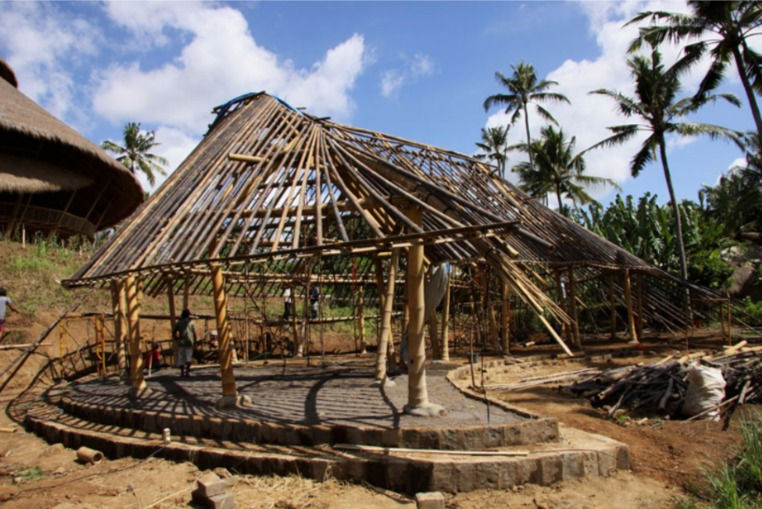

Fun fact: This design won the 2019 Stephen R. Kellert Biophilic Design Award.


Comments